
Not only do the people in our trees have stories, the stuff in our house does, too. Some of it we’ve brought into our lives, others was passed down to us from relatives that have died. But, the chances are, when we’re gone, not many of those objects will mean anything to anyone else unless we’ve specifically shared the stories behind them. Maybe that’s OK for some things–a t-shirt that was special to us may not need to be kept or passed down–but other things, like a locket that belonged to a great-grandparent, should probably be preserved and saved for another generation.
I went around and around in my head about the best way to save these stories, and how to encourage my parents to do the same. Initially I was thinking just a Google Doc would do the trick. Or maybe I’d build out something on Airtable. But then I came across Artifcts and I realized I’d found my solution.
Actually, to be truthful, I skipped over Artifcts the first time or two I saw it, probably as a RootsTech vendor or something. “Interesting idea,” I thought, but my typical concerns about these very specific services came up: Would the UI be good? Is it secure? Most importantly: can I get my data out of it?
Thankfully, after investigating these concerns, I am more than satisfied.
Background
Artifcts was inspired by the passing the co-founder Heather’s mother. Though she was glad to have things that were important to her mother, she didn’t know the story behind lots of them. This inspired her to create a service that would make it easy for others to tell and share these stories before it was too late.
Interface
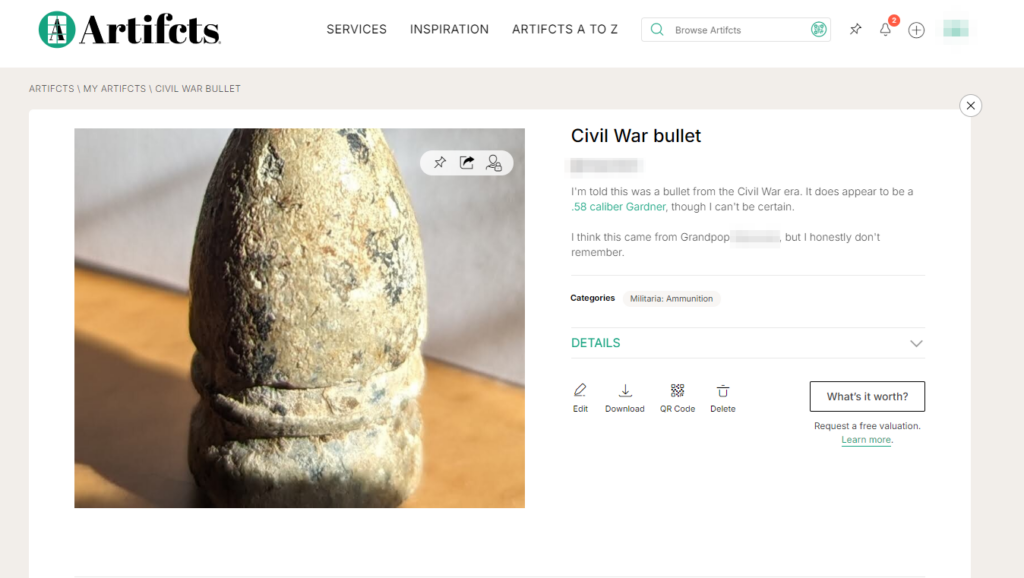
The UI for adding a new item is simple by default, allowing you to add up to five photos, videos, or audio files, name and describe your item, write a story about it, note its country of origin, and designate how you want the item handled in the future. Additionally, you can open the “full form” view which provides the chance to add additional metadata about the item’s provenance and physical features (I like the “current location” field).
Likewise, the display page for each item is clean and well laid out. Your collection can be viewed as a list, tiles, a flipbook, or–interestingly–in a timeline view.
A poor UI could really kill a product like this, but I’ve got no complaints about Artifcts on that front.
Security and Privacy
With the company started by two former CIA employees, I had an expectation that security and privacy would be taken into consideration. They certainly were.
Their site outlines their security measures, which include 256-bit AES protection for files at rest and SSL (natch) for files in transit. And to show they’ve given extra thought, shared artifacts have sensitive data like location, value, and documentation kept private.
Similarly, I like their approach to privacy. Items are private by default but can be shared with members or anyone with an email address or with the public.
Lastly, a nice feature Artifcts offers is a legacy contact option to designate will be contacted and given access to your collection in the event of your passing.
Export Capability
This is one of the most important pieces of the puzzle for me because if I’m going to spend time taking pictures, writing or recording stories, and fleshing out metadata, I don’t want to worry about the site shutting down and taking my data with it or only offering some unusable XML export. When I saw what Artifcts offers, I was hard pressed to find anything to complain about.
From your main collection page, there is a “Download My Artifcts” link that lets you get an Excel file, a CSV, a PDF, or a ZIP file of your collection at any time. The ZIP file contains an Excel spreadsheet of your collection as well as any images or recordings you’ve made. Perfect.
Other Interesting Features
While I’m not a huge fan of QR codes in general, I do like that Artifcts offers the ability to tie QR codes to individual Artifcts pages. You can either buy a sheet of QR code stickers that you can stick to items or print out a unique QR code to use. This approach could make it a little bit easier for others to hunt down information about items that are important to you after you’re gone.
Artifcts also partner with Akin to create books with your collection and you can get individual free informal valuations on your items from Heritage Auctions.
Price
As of summer 2024, they offer a free plan that lets you add five items to test out the service. For $45 a year you can add up to 30 items and get some bonus features. This, honestly, doesn’t seem like a plan I would opt for. If I’m going to pay, I’m going all in and don’t want restrictions.
For $119/year, you get unlimited entries. That initially sounded like a bit much to add to an already large list of genealogy services I subscribe to, but with an unlimited subscription you also get three additional unlimited gift subscriptions to give to friends and family! This averages out to $30/year for four unlimited accounts, which is more than reasonable. Artifcts also occasionally offers coupons which could discount your first year a bit.
Conclusion
I’m still in the early stages of using Artifcts, but I am thoroughly impressed by it. The UI is solid, the price is reasonable, the metadata tied to each item is useful, and the privacy controls are solid. I hope they offer 2FA at some point, but overall, I don’t hesitate to recommend Artifcts at all. It serves an important, specific purpose and it does so safely and elegantly.