
When I initially started this page, I considered some uses of AI in genealogy as harmless parlor tricks that didn’t really offer anything positive but also weren’t necessarily dangerous. Just mere distractions.
In 2026, after a few years of seeing how AI is being adopted in general, my view has changed a bit. I think that there are certainly some helpful uses of AI/ML, particularly around traditionally volunteer tasks like first-take indexing, transcription, and translation. This is where AI shines: taking a first shot at getting loads of data online and making it discoverable. Then, fine tuning and correction can happen at a user-level.
But when we start getting into uses of generative AI for creating images that never existed or creating videos? This is downright dangerous. There’s a reason “AI slop” as a phrase took hold in 2025.
Even in the best case scenario where GenAI imagery is marked as such (and it rarely is), it has no place in a good genealogy because it is not fact or even an interpretation of facts. It’s a non-creative creation of a machine that can’t show its work. When I see clearly AI image of someone in a tree, I find myself instantly doubting the rest of the person’s work because they’re willing to accept GenAI slop in their tree.
My feelings on AI being used in the writing and research process is a bit more complicated. I’ve seen some good use of NotebookLM for collecting and “interrogating” small sets of data, but I largely think LLM chatbots are a waste of time for the research process. And while I can accept AI being used for standard computer tasks of proofreading, grammar checks, etc. it rubs me the wrong way when it’s being used for large chunks of writing. AI writing has no personality and if there’s anywhere that needs personality injected, it’s writing about one’s own family.
If AI in genealogy is intriguing to you, The Family History AI Show podcast (hosted by Mark Thompson and Steve Little) may be of interest. I have not listened recently, so I can’t speak to how closely they’re aligning with my own take on things, but they do a good job of staying on top of new releases and trends.
Important caveat: The ethics of how large AI companies operate and the substantial carbon footprint they create are serious considerations in one’s use of AI-powered tools. I acknowledge this and, honestly, feel conflicted even talking positively about uses of AI in genealogy here. I’m still thinking through those implications and the trade-offs. I hope the future has more companies that operate their training ethically and sustainably, though I don’t feel terribly hopeful on that front.
Transcribing a Land Deed and Then Summarizing It
Here’s the thing: even when transcribing the text of a land deed, the text is often so dense and written in a legal hand such that it’s nearly impeneterable, even if the transcription is 100% accurate (which it isn’t).
Then, I had a thought.
I started by grabbing some AI-transcribed text from a land deed on FamilySearch:
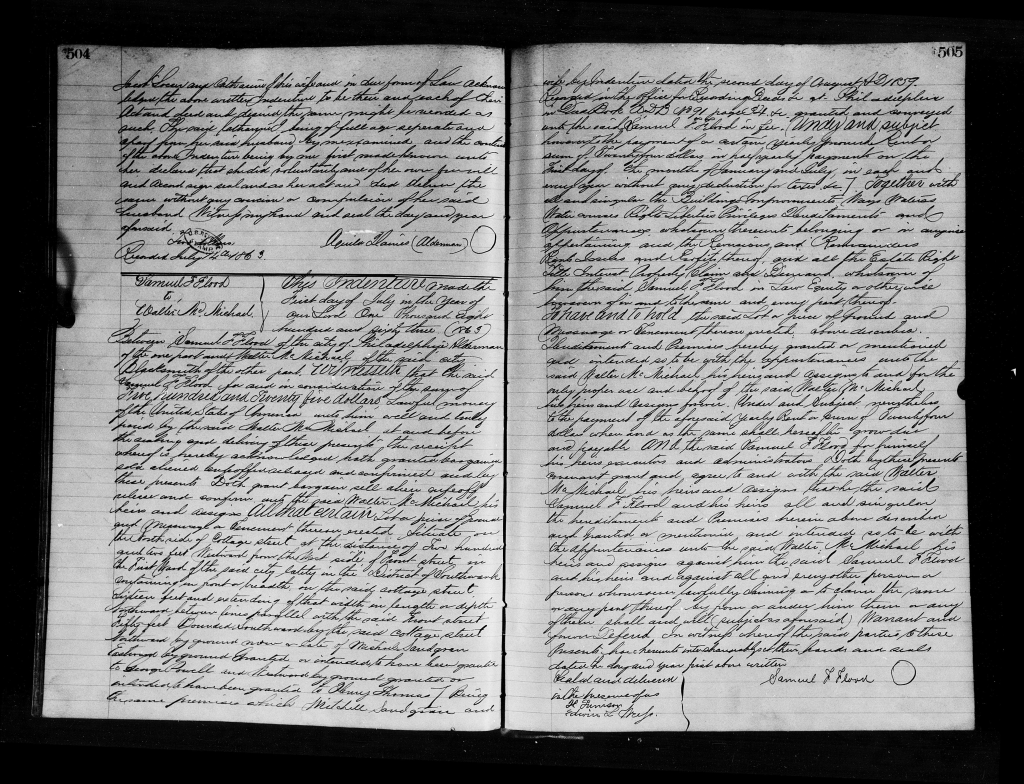
It was far from perfect, but I didn’t do anything to clean it up. I took the text, pasted into Copilot (which uses ChatGPT) and asked, “I’ve got this transcribed text of a land deed that is somewhat messy and hard to read. Summarize this following text so that an eighth grader would understand it.”
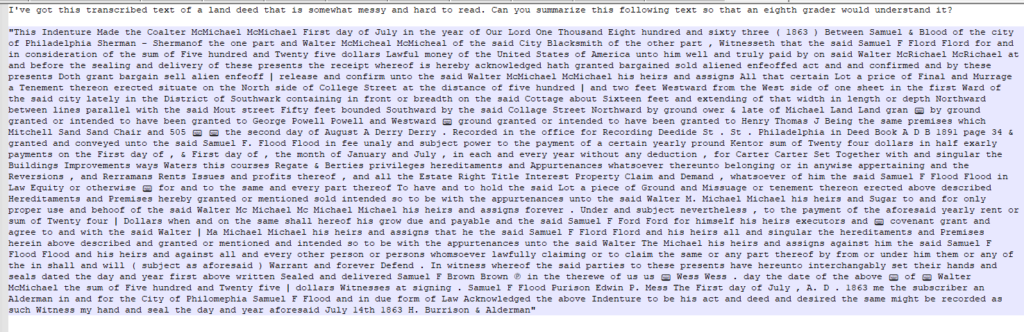
And I’ll be darned if it didn’t do just that. Not only is it taking legalese from the 1800s and summarizing it in an easy-to-read way, it’s somehow overcoming the messy transcription:
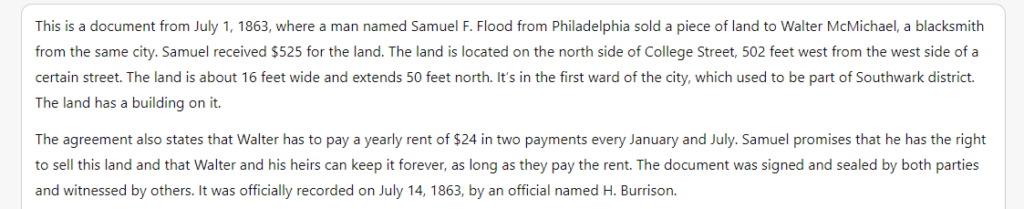
I feel like this is one of the less evil uses of AI that I might be able to get behind.
As of July 2024, FamilySearch now has AI-generated summaries available for some record sets (note, however, it will only summarize a single page, not a multiple-page document).
Transcribing a Handwritten Image and then Translating It
With the free ChatGPT-4o, I tossed it a Lithuanian birth record with the prompt, “This image contains handwriting in Lithuanian. Can you transcribe it and then translate it to English?”
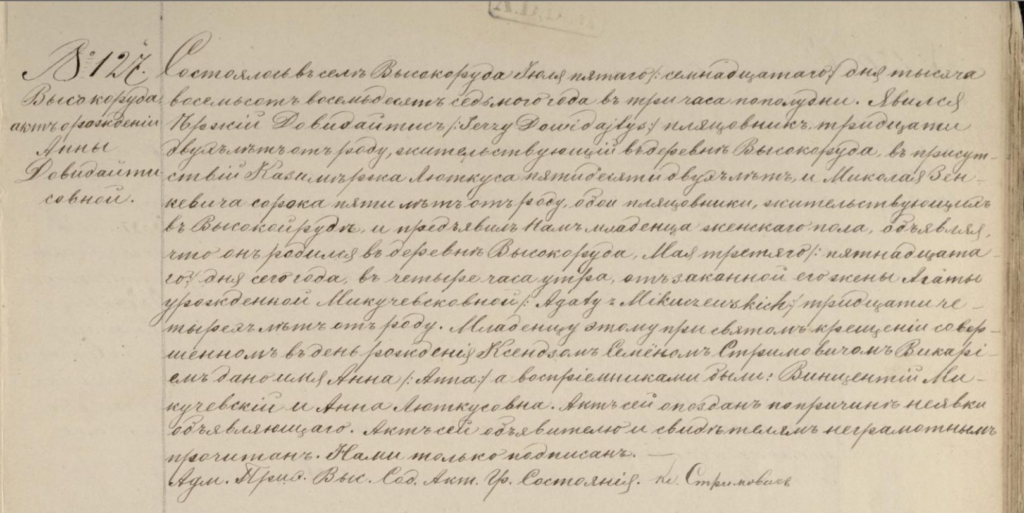
And I’ll be damned if it didn’t “actually…” me:
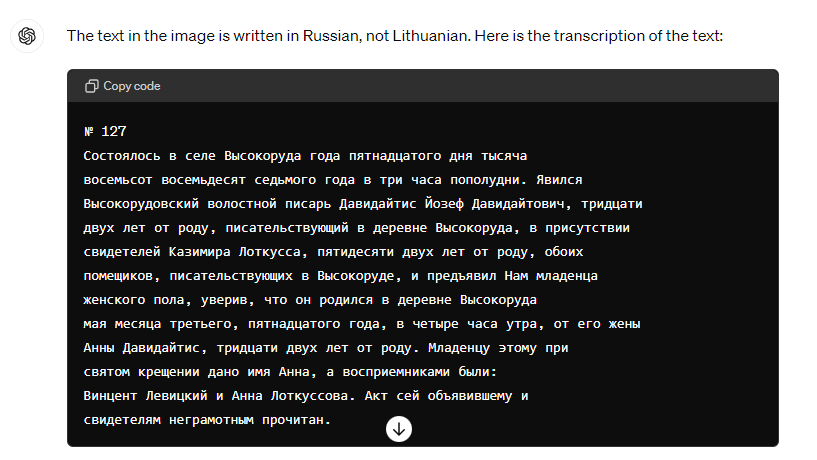
It then provided a translation:
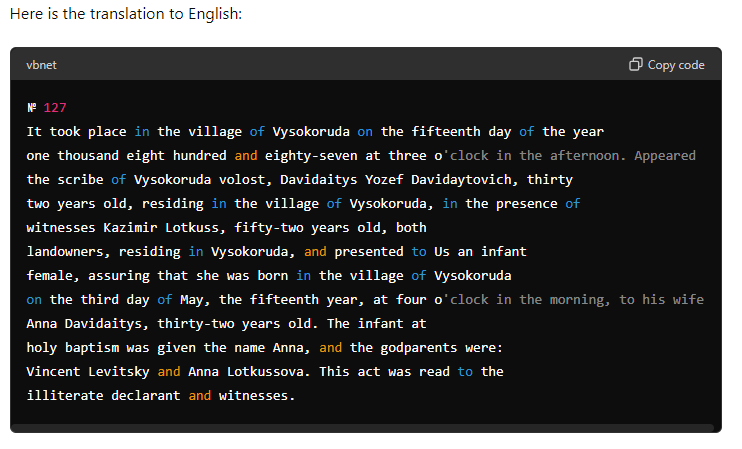
Having worked with Lithuanian cousins that translated this document originally for me, this is a pretty decent translation. The names clearly provided the most trouble, but the idea that you can take a handwritten document, not recognize the language the handwriting it’s in, and manage to get a rough English transcription in a matter of seconds is pretty darn powerful.
Querying Your Own Documents
In October 2024, Google opened up NotebookLM, which allows you to point it at your own documents and interact with them in a chatbot-type fashion. Google says they do not use your documents for training (but, of course, I still wouldn’t use it on data I wouldn’t want someone else seeing or having access to).
In my test, I uploaded my narrative family history books and asked NotebookLM to list all of my ancestors that fought in the Civil War and which regiment they were in. It was complete and accurate in its response. This is useful.
Not as useful and also super creepy–but admittedly technically impressive–is NotebookLM’s audio summary of your data. It’s essentially a two-person podcast-like discussion based on what you’ve pointed it at. I did find two random people talking about my family history like it was the most interesting thing ever to be both engaging and discomforting. Accuracy was quite good, only misstating facts a couple of times in 24 minutes. I’m not sure why the “hosts” had to themselves say they were related to everyone in the book (and at one point claiming authorship of it!), but nevertheless, it’s one of those very interesting uses of AI that could absolutely make the Internet a much, much worse place to try and find useful content. We do not need piles of AI-hosted podcasts popping up in the podcast platforms.